Over the past few years, LLMs have developed rapidly, significantly expanding our cognitive capabilities. Many people probably now turn to AI first when they encounter a problem. It may be that LLMs already know more than my brain does, and perhaps possess higher reasoning abilities than my brain.
However, in this article, I will discuss why relying on LLMs is simply too slow when it comes to unleashing creativity.
The inspiration for this idea came from a Japanese article titled “Thinking Before Doing Is Too Late” by Lego creator Jumpei Mitsui.
To briefly summarize the article: when engaging in creation, beginners have their brain resources drained by the sheer act of making things, even before they can think about coming up with good ideas. For example, when drawing a picture, they become so absorbed in trying to draw correctly, worrying about whether lines are straight or the perspective is right, that they have no mental bandwidth left for generating ideas. Experts, on the other hand, perform this phase unconsciously, skipping the “how-to” thinking process, which allows them to fully exercise their ideation. In other words, in the following flow:
(a) Come up with an interesting idea
(b) Think about how to shape it
(c) Move your hands to shape it
A beginner’s process looks like this:
(a) -> (b) -> (c) -> (a) -> (b) -> (c) -> (a) -> …
However, an expert’s process looks like this:
(a) -> (c) -> (a) -> (c) -> (a) -> (c) -> (a) -> …
This means the cycle of shaping ideas accelerates. It can be said that creative thinking is possible precisely because the act of creation can be done at an unconscious level. As a result of no longer spending brain resources on “how to make it,” creators can focus and allocate their resources to the essential part of artwork: “how to make it interesting.” The professional world is where the real game begins only after you can do things unconsciously.
At this point, you can probably understand what I mean by saying that using an LLM is too slow. Today, even beginners can collaborate with LLMs to shape their ideas, as long as they have one. That is, the following flow is now possible:
(a) Come up with an interesting idea
(b) Consult an LLM on how to do it
(c) Move your hands to shape it
Beginners will create using this flow:
(a) -> (b) -> (c) -> (a) -> (b) -> (c) -> (a) -> …
But this is too slow. If there is a concern with the output, you have to repeat the process of consulting the LLM on how to fix it and then making the change. Experts can run everything themselves without consulting an LLM. That is, for experts:
(a) -> (c) -> (a) -> (c) -> (a) -> (c) -> (a) -> …
And the cycle of shaping ideas accelerates.
True, the performance and quality of LLMs are improving daily. However, this problem will not disappear. This is due to Amdahl’s Law. Amdahl’s Law is a principle in computer parallel processing stating that the overall speedup of a program is limited by the fraction of the program that cannot be parallelized. Interaction with an LLM consists of three elements:
(i) Inputting a prompt to the LLM
(ii) The LLM performing the computation
(iii) Reading the LLM’s output
Element (ii) advances daily with the evolution of GPUs and algorithms, but there is a limit to how much (i) and (iii) can be sped up.
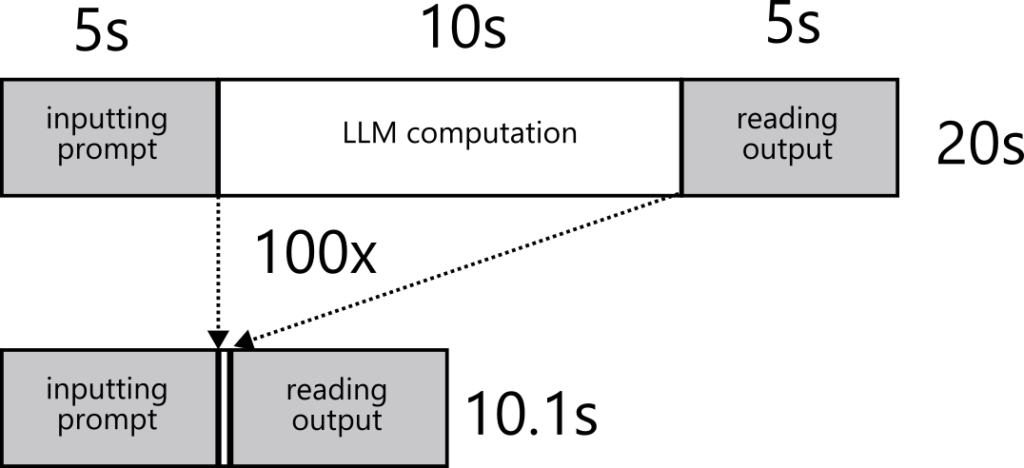
On the other hand, there is virtually no limit to the speed of dialogue within the brain.

It is true that LLMs have become highly sophisticated; they may know more than my brain and have higher reasoning capabilities. However, their weakness is that they exist outside my body. The strength of my brain is that it is inside my body and is the computing unit I can access the fastest.
This can also be understood through the analogy of the computer memory hierarchy. A computer has registers, which can store only a little, and main memory, which can store a lot. Looking only at storage capacity, main memory might seem sufficient, but registers are crucial. Registers are located inside the CPU and can be accessed by the CPU in a very short time. The CPU can process computations at high speed thanks to registers.
Humans are the same. Ultimately, the brain is physically the closest and possesses the privilege of being accessible at the highest speed. This is something that LLMs cannot replace.
In recent years, agents using LLMs have been developing, and this can also be derived from this discussion. An LLM is strictly an “other,” an entity to which you outsource work. As an external worker, there is no doubt that it is extremely excellent. However, you can’t outsource intuition. The brain will forever retain its role as the inner loop that runs the cycle of shaping ideas.
This blog post, too, was completed by running the cycle of shaping ideas within my own brain.
I hope this article provides an opportunity for you to think about the division of roles between yourself and LLMs.
Author Profile
If you found this article useful or interesting, I would be delighted if you could share your thoughts on social media.
New posts are announced on @joisino_en (Twitter), so please be sure to follow!

Ryoma Sato
Currently an Assistant Professor at the National Institute of Informatics, Japan.
Research Interest: Machine Learning and Data Mining.
Ph.D (Kyoto University).